
Precision in Practice: Why Blair Upper Cervical Imaging Looks at the Entire Neck

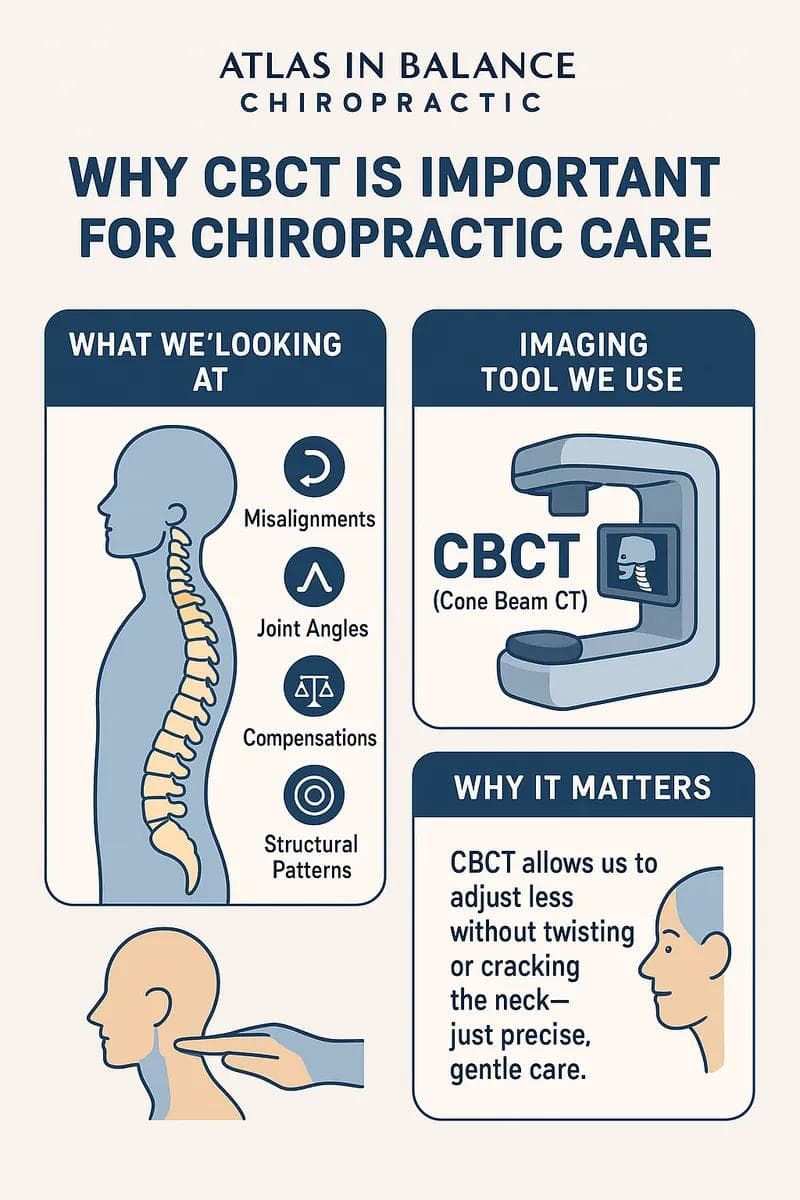
Unlike general chiropractic care, which often focuses on full-spine manipulation, Blair work is about correcting specific structural misalignments in the cervical spine that interfere with nervous system function. While the top vertebrae (C1 and C2) are often involved, misalignments can exist throughout the entire neck—from C1 through C7—and that’s exactly why we image the full cervical spine.
We use CBCT (Cone Beam CT) because our goal is simple: see it clearly, measure it precisely, and correct it specifically. To see is to KNOW. To not see is to GUESS.
Why Imaging Matters in Blair Work
Blair chiropractic is based on the principle that no two people are built the same. Your joints are angled differently than someone else's, your misalignment pattern is unique, and so is the way your body compensates.
We don’t guess.
We don’t rely on feel.
We image—because structure dictates function, and we need to see yours in detail.
CBCT: A 3D View of Your Cervical Spine
CBCT (Cone Beam Computed Tomography) gives us a full, 3D image of your cervical spine—allowing us to see the exact orientation of your joints, bone structure, and misalignments with high accuracy and low radiation.
What we can detect with CBCT:
• Precise misalignments in all cervical segments
• Joint plane angles unique to your anatomy
• Side-slip displacements that can’t be felt or seen in standard X-rays
• Degenerative changes or anomalies that impact your care plan
The Blair technique depends on this level of clarity—especially since we don’t adjust unless there’s a measurable, image-confirmed need to.
Blair Analysis: Tailored, Targeted, and 100% Specific
We also use Blair-specific analysis, which is where we take the CBCT, or 3D image of your neck and create a custom care plan based on your unique anatomy and posture. These aren’t standard medical films and analysis—they’re taken with precise head positioning to capture the actual joint orientations, not just general neck structure so we can truly see how the spine and joints are oriented.
These films show us:
• Where segmental misalignments have occurred
• How your head and neck relationship has shifted
• Which joint(s) need to be corrected—and which don’t
With Blair analysis, we often find that the true primary misalignment is not where the pain is. That’s why we look at the whole cervical spine—to identify the true root cause, not just chase symptoms.
Beyond the Atlas: Why We Assess C1 Through C7
A lot of upper cervical techniques stop at C1 and C2. The way we do Blair here at Atlas in Balance doesn’t.
Misalignments can happen at any level of the neck—and often, lower cervical segments are compensating for a primary issue at the top. If those compensations are never assessed or addressed, healing stalls.
By imaging the full cervical spine, we’re able to:
• Track how the body is adapting—or failing to adapt
• See long-term structural changes
• Deliver more effective, long-lasting corrections
In short: we correct what needs to be corrected—and only what needs to be corrected before moving on to the rest of the body.
Final Thoughts
Imaging is how we take the guesswork out of care. With CBCT (Cone Beam CT), we’re able to see your cervical spine in three dimensions, allowing for unmatched accuracy in identifying misalignments and structural patterns.
Our goal is always the same: to provide care that’s based on your structure, your needs, and your healing potential—not a one-size-fits-all approach.
If you've never had your entire neck evaluated structurally and specifically with CBCT, it might be time to take a deeper look. The clarity it provides could reveal the root cause of what’s been holding you back.
From your friendly neighborhood Chiropractor,
Caitlin Walker DC cAVCA MAT ATC